Plans for real training lives
The method changes with the movement. The honesty does not.
Your selected movement styles determine what kind of week gets built, which evidence applies, and which limitations stay visible.
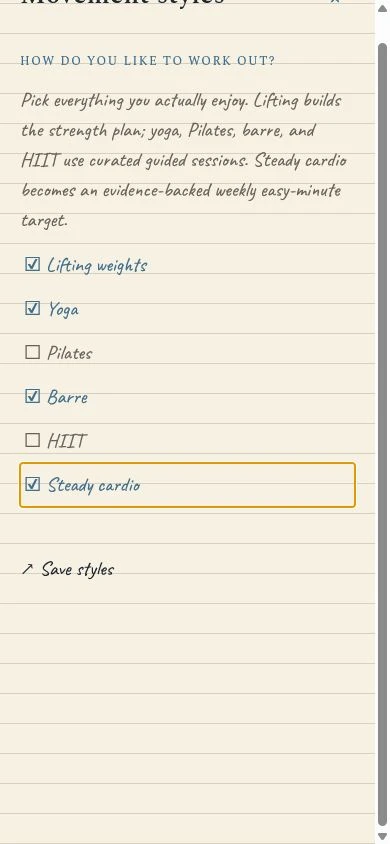
Choose a route
Six starting points. Any recoverable combination.
The planning contract
What the planner may—and may not—do.
- It may prioritize.
- When every preferred session cannot fit, the planner selects the styles most relevant to the goal and names what waits.
- It may trim.
- With a short session budget, optional accessories go before the main training signal.
- It may state a gap.
- No resistance stimulus, no vertical pull, or too little formal time remains visible as a limitation.
- It may not invent.
- AI cannot choose exercises, change volume, fabricate videos, or relax equipment eligibility.
What changes
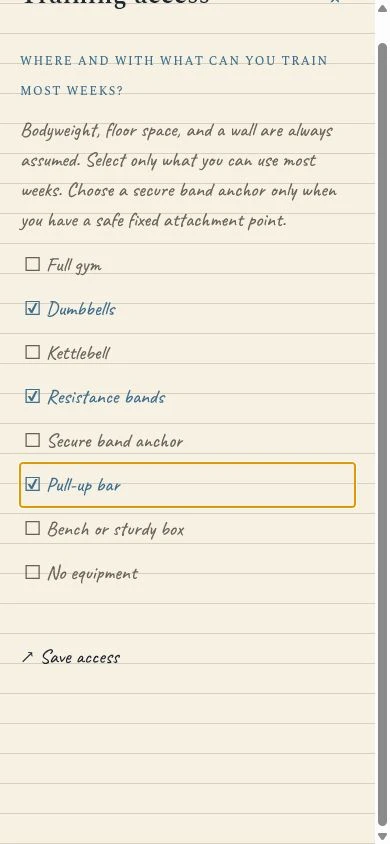
Same inputs. Different planning consequences.
| Input | Lifting plan | Guided plan | Cardio-only plan |
|---|---|---|---|
| Equipment | Filters every exercise and substitute | Filters chair, mat, and light-weight sessions | Shapes the modality hint |
| Session time | Trims accessories in a fixed order | Filters session duration | Caps formal minutes per day |
| Experience | Changes split, volume, and prescription | Filters session level | Favors repeatable easy work |
| Goal | Changes volume and progression emphasis | Ranks recovery, core, conditioning, or flexibility | Changes the weekly aerobic dose |
| Recent work | Flags stalls, pain, and volume jumps | Protects weekly recovery capacity | Keeps hard minutes from stacking |
Early access on iOS
Your week should look like your training.
Choose the styles, days, time, and equipment you actually have. Flexbound handles the planning rules in the notebook.